By Abidemi Adebamiwa
Executive Context
U.S.-aligned capital is increasingly prioritizing critical minerals as part of a broader effort to diversify global supply chains, reduce overconcentration risk, and secure long-term access to strategic industrial inputs. This shift is driven by electrification, advanced manufacturing, defense, and food-security considerations rather than speculative commodity demand.
Nigeria presents a credible opportunity within this framework, not as a volume competitor to incumbent producers, but as a selective diversification node. Its relevance depends on project bankability, subnational governance discipline, and the ability to execute under environmental, social, and governance standards acceptable to U.S. public and private financiers.
This brief outlines what U.S. investors and lenders prioritize, assesses state-level readiness across Nigeria, and clarifies the project structuring features typically required for financing associated with the U.S. International Development Finance Corporation and the Export–Import Bank of the United States.
Strategic Rationale: Why Critical Minerals Matter to U.S. Capital
U.S. investor interest extends beyond rare earth elements and is organized around five strategic use cases:
- Electrification and Permanent Magnet Systems
Inputs critical to electric vehicles, grid infrastructure, and advanced industrial equipment. - Semiconductors and Electronics Manufacturing
By-products linked to lead–zinc and bauxite systems that feed electronics supply chains. - Aerospace and High-Temperature Alloys
Tungsten-style pathways supporting performance-critical applications. - Nuclear and Strategic Industrial Inputs
Zirconium-associated systems and related specialty minerals. - Food Security and Fertilizer Inputs
Phosphate and potash required to stabilize fertilizer supply and mitigate food-price volatility.
Policy implication: Nigeria does not need to displace established suppliers. It must demonstrate reliability, traceability, and financeability.
State-Level Readiness Assessment
State readiness is evaluated using five criteria: mineral potential, byproduct logic, logistics access, scalability, and governance signals.
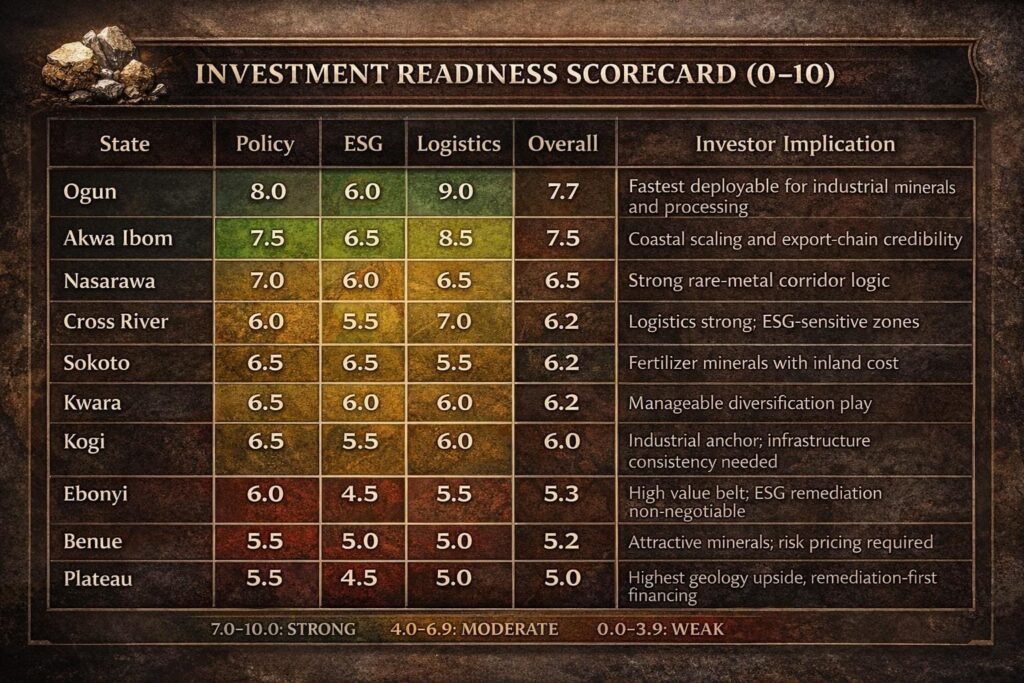
The states with the strongest near- to medium-term relevance include Plateau, Nasarawa, Cross River, Akwa Ibom, Kogi, Ebonyi, Sokoto, Benue, Kwara, and Ogun. Their readiness varies significantly once policy consistency, ESG exposure, and logistics are priced.
Comparative Investment Readiness Matrix (0–10)
Interpretive note:
Geological potential alone does not unlock capital. Low-friction states receive first allocations, while higher-upside jurisdictions attract financing only after governance credibility and ESG discipline are demonstrated.
Project Structuring Considerations for U.S.-Aligned Financing
Projects that attract U.S. development and export-credit finance typically share four features:
Phased Development
Verification and sampling precede modest concentration or pre-processing, with scale-up tied to offtake and operating history.
ESG Embedded at Inception
Community benefit frameworks, land and water management plans, and traceability systems are required from day one.
By-Product Economics
Multi-recovery structures improve resilience and financing defensibility.
Conservative Processing Assumptions
Preference for separation and concentration rather than capital-intensive refining claims.
Risk Factors Priced by Investors
- Regulatory uncertainty and title disputes
- Informal mining leakage and weak traceability
- Community conflict and ESG exposure
- Infrastructure reliability, power, roads, ports
- Security costs embedded into feasibility models
Policy Actions to Improve Capital Mobilization
- Establish early credibility through deployable projects in Ogun and Akwa Ibom
- Develop structured mineral corridors in Nasarawa, Cross River, and Kogi
- Apply remediation-led financing models in Plateau and Ebonyi
- Advance fertilizer mineral projects in Sokoto, aligned with food-security and inflation policy
Core Takeaway
U.S. critical-minerals capital will deploy where projects are bankable, governance is predictable, ESG standards are enforced, and logistics function reliably. Early investment will concentrate in low-friction states capable of credible execution, while states with higher geological potential will attract capital only after institutional discipline is demonstrated through delivery. Within this landscape, ABT Investment & Consulting LLC operates at the project-readiness and policy-alignment layer, supporting state governments and sponsors in translating mineral potential into phased, financeable projects that meet U.S. development-finance and export-credit standards, embed ESG and traceability from inception, and allow investor interest to mature into executable investment pathways.

0 Comments